| Comment: | enjoin pluginconf (python implementation here) |
|---|---|
| Downloads: | Tarball | ZIP archive | SQL archive |
| Timelines: | family | ancestors | descendants | both | trunk |
| Files: | files | file ages | folders |
| SHA3-256: |
4b8c748142563f9ccbfaf8f98a0569ba |
| User & Date: | mario on 2022-10-25 22:06:05 |
| Other Links: | manifest | tags |
|
2022-10-26
| ||
| 05:13 | pylint fixes, support for ##type:, shift depends into separate module check-in: 6466a162be user: mario tags: trunk | |
|
2022-10-25
| ||
| 22:06 | enjoin pluginconf (python implementation here) check-in: 4b8c748142 user: mario tags: trunk | |
|
2018-05-18
| ||
| 13:51 | initial empty check-in check-in: db9f884efc user: mario tags: trunk | |
Added LICENSE version [abbf309598].
> | 1 | Publid Domain |
Added README.md version [c783f5eaf0].
> > > > > > > > > > > > > > > > > > > > > > > > > > > > > > > > > > > > > > > > > > > > > > > > > > > > > > > > > > > > > > > > > > > > > > > > > > > > > > > > > > > > > > > > > > > > > > > > > > > > > > > > > > > > > > > > > > > > > > > > > > > > > > > > > > > > > > > > > > > > > > > > > > > > > > > > > > > > > > > > > > > > > > > > > > > > > > > > > > > > > > > > > > > > > | 1 2 3 4 5 6 7 8 9 10 11 12 13 14 15 16 17 18 19 20 21 22 23 24 25 26 27 28 29 30 31 32 33 34 35 36 37 38 39 40 41 42 43 44 45 46 47 48 49 50 51 52 53 54 55 56 57 58 59 60 61 62 63 64 65 66 67 68 69 70 71 72 73 74 75 76 77 78 79 80 81 82 83 84 85 86 87 88 89 90 91 92 93 94 95 96 97 98 99 100 101 102 103 104 105 106 107 108 109 110 111 112 113 114 115 116 117 118 119 120 121 122 123 124 125 126 127 128 129 130 131 132 133 134 135 136 137 138 139 140 141 142 143 144 145 146 147 148 149 150 151 152 153 154 155 156 157 158 159 160 161 162 163 164 165 166 167 168 169 170 171 172 173 174 175 176 177 178 179 180 181 182 183 184 185 186 187 188 189 |
Provides meta data extraction and plugin basename lookup. And it’s meant for
in-application feature and option management.
The [descriptor format](https://fossil.include-once.org/pluginspec/index)
(*self-contained* atop each script) is basically:
# encoding: utf-8
# api: python
# type: handler
# category: io
# title: Plugin configuration
# description: Read meta data, pyz/package contents, module locating
# version: 0.5
# priority: core
# docs: http://fossil.include-once.org/streamtuner2/wiki/plugin+meta+data
# config:
# { name: xyz, value: 1, type: bool, description: "Sets..." }
# { name: var, value: "init", description: "Another..." }
# license: MITL
#
# Documentation goes here...
The `key: value` format is language-agnostic. It’s basically YAML in the
topmost script comment. For Python only # hash comments are used. Defaults
to rather common field names, encourages a documentation block, and an
obvious [config: { .. } scheme](https://fossil.include-once.org/pluginspec/wiki/config)
for options and defaults.
How it's used:
import pluginconf
meta = pluginconf.plugin_meta(fn="./plugin/func.py")
print(meta)
What it’s not:
> * This is not another config reader/parser/storage class.
> * Doesn’t impose a specific plugin API.
> * Neither concerns itself with module/package loading. (See [pluginbase](https://pypi.org/project/pluginbase/) or just `__import__`.)
What for then?
> * Separates code from meta data. Avoids keeping seldomly used descriptors in variables.
> * Does away with externalized ini/json files for modules, yet simplifies use of external tooling.
> * Minimizes premature module loading just to inspect meta information.
pluginconf is less about a concrete implementation/code, but pushing a universal meta data format.
# API
Lookup configuration is currently just done through injection:
plugin_base = [__package__, "myapp.plugins", "/usr/share/app/extensions"]
module_base = "pluginconf" # or any top-level app module
Which declares module and plugin basenames, which get used for lookups by
just module= names in e.g. `module_list()`. (Works for literal setups
and within PYZ bundles).
This is unnecessary for plain `plugin_meta(fn=)` extraction.
#### plugin_meta( module= | fn= | src= | frame= )
Returns a meta data dictionary for the given module name, file, source code, or caller frame:
{
"title": "Compound★",
"description": "...",
"version": "0.1",
"type": "channel",
"category": "virtual",
"config": […],
"doc": "The multiline comment \n following meta fields..."
…
}
And that’s already all it does.
All other methods in pluginconf are mostly just for module lookup or data
retrieval.
#### module_list()
Returns basenames of available/installed plugins (from possible sources
in `plugin_base`).
#### add_plugin_defaults()
Populates your config_options{} and plugin_states{} list. Can be a classic dict,
or one of the hundreds of config parser/managers. You might want to combine
config options and plugin states in a single dict even:
import pluginconf
pluginconf.module_base = __name__
pluginconf.plugin_base = [__package__]
conf = {
"defaults": "123",
"plugins": {} # ← stores the activation states
}
for module,meta in pluginconf.all_plugin_meta().items():
pluginconf.add_plugin_defaults(conf, conf["plugins"], meta, module)
# share the same dict ↑ ↑
#### get_data( fn= )
Is mostly an alias for pkgutil.get_data(). Abstracts usage within PYZ packages a little.
#### argparse_map()
Provides a simpler way to specify ugly argparse definitions. And allows to amass options from plugins.
# GUI
There's a Tkinter/PySimpleGUI variant of the option dialog from
[streamtuner2](https://fossil.include-once.org/streamtuner2/) included:
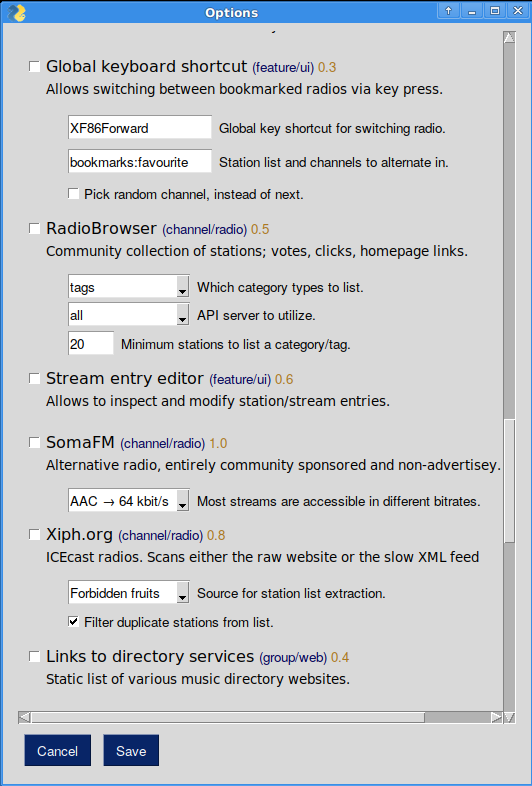
The `pluginconf.gui.window()` implementation has a few less features, but
might suffice for common applications. It just lists a single pane of
settings, and doesn't even attempt to group by categories.
Its main function performs the plugin lookup (`*.py` meta reading) and
displays an editing window:
import pluginconf.gui
config = {
"debug": 0, "verbose": 1, "temp_dir": "/tmp"
}
plugin_states = {
"core": 1, "printing_ui": 0
}
pluginconf.gui.window(config, plugin_states, files=["./library/*.py"])
Where both `config` and `plugin_states` get updated after invocation. The
function return value indicates whether save or cancel was pressed.
* `plugin_states={}` can be omitted/empty, but the GUI will still display
checkboxes for plugin files, even if they go unused.
* Supports only basic option types (bool, str, int, select), no table/dict.
* Type casting is somewhat basic (no integer regex).
* And doesn't support nested config names=`app[module][var]` yet.
* The config dict might be prefilled from either in-app defaults,
or `json.load()`, and/or per `pluginconf.add_plugin_defaults()`.
* It's still up to the application how/where to store the config{} dict (e.g. `json.dumps()`).
* And alternatively to the *.py glob list, you could inject a prepared
dictionary as `plugins={}` list (keys are unused) and leave `files=None`.
* Any PySimpleGUI options (title=, theme=, resizable=) are passed through to
the config window.
Overall it's surprisingly short given the PySimpleGUI result set. It would
likely behave as well, if e.g. additional tabs or input widgets were added.
# setup.py wrapper
Another obvious use case for PMD is simplifying packaging. A `setup()`
script can become as short as:
from pluginconf.setup import setup
setup(
fn="main/pkg.py"
)
Which will reuse version: and descriptors from the meta comment. For simple
one-module packages, you might get away with just `setup()` and an all
automatic lookup. The non-standard PMD field `# classifiers: x11, python`
can be used to lookup trove categories (crude search on select topics).
All other `setup(fields=…)` are passed on to distutils/setuptools as is.
-- Btw, [setupmeta](https://pypi.org/project/setupmeta/) is an even more
versatile wrapper with sensible defaults and source scanning.
#### Caveats
* It’s mostly just an excerpt from streamtuner2.
* Might need customization prior use.
* The GUI implmentation is fairly simplistic.
* Doesn't bundle any plugin repo loader logic.
* So doesn't make use of the dependency class.
* The description fields can double as packaging source (setup.py). There's also a
[# pack: specifier](https://fossil.include-once.org/pluginspec/wiki/References)
for fpm (deb/rpm/arch/exe/pyzw/pip generation), unused in the `setup.py`
wrapper here however.
* In Python `# type:` might neede doubled commenting (## pylint), or alternating to
other descriptors like`class:` or `slot:`. (The whole scheme is agnostic to
designators. Common keys are just recommended for potential interoparability.)
* The format incidentally mixes well with established comment markers like
`# format: off` or `# pylint: disable=…` for instance.
|
Added TODO version [da0e159b0a].
> > | 1 2 | - argparse - pmd2inks |
Added g.py version [6232d90483].
> > > | 1 2 3 |
#!/usr/bin/env python3
import pluginconf.gui
pluginconf.gui.window({}, {}, ["../streamtuner2/channels/*.py"])
|
Added pluginconf/__init__.py version [dd2e021c4c].
> > > > > > > > > > > > > > > > > > > > > > > > > > > > > > > > > > > > > > > > > > > > > > > > > > > > > > > > > > > > > > > > > > > > > > > > > > > > > > > > > > > > > > > > > > > > > > > > > > > > > > > > > > > > > > > > > > > > > > > > > > > > > > > > > > > > > > > > > > > > > > > > > > > > > > > > > > > > > > > > > > > > > > > > > > > > > > > > > > > > > > > > > > > > > > > > > > > > > > > > > > > > > > > > > > > > > > > > > > > > > > > > > > > > > > > > > > > > > > > > > > > > > > > > > > > > > > > > > > > > > > > > > > > > > > > > > > > > > > > > > > > > > > > > > > > > > > > > > > > > > > > > > > > > > > > > > > > > > > > > > > > > > > > > > > > > > > > > > > > > > > > > > > > > > > > > > > > > > > > > > > > > > > > > > > > > > > > > > > > > > > > > > > > > > > > > > > > > > > > > > > > > > > > > > > > > > > > > > > > > > > > > > > > > > > > > > > > > > > > > > > > > > > > > > > > > > > > > > > > > > > > > > > > > > > > > > > > > > > > > > > > > > > > > > > > > > > > > > > > > > > > > > > > > > > > > > > > > > > > > > > > > > > > > > > > > > > > > > > > > > > > > > > > > > > > > > > > > > > > > > > > > > > > > > > > > > > > > > > > > > > > > > > > > > > > > > > | 1 2 3 4 5 6 7 8 9 10 11 12 13 14 15 16 17 18 19 20 21 22 23 24 25 26 27 28 29 30 31 32 33 34 35 36 37 38 39 40 41 42 43 44 45 46 47 48 49 50 51 52 53 54 55 56 57 58 59 60 61 62 63 64 65 66 67 68 69 70 71 72 73 74 75 76 77 78 79 80 81 82 83 84 85 86 87 88 89 90 91 92 93 94 95 96 97 98 99 100 101 102 103 104 105 106 107 108 109 110 111 112 113 114 115 116 117 118 119 120 121 122 123 124 125 126 127 128 129 130 131 132 133 134 135 136 137 138 139 140 141 142 143 144 145 146 147 148 149 150 151 152 153 154 155 156 157 158 159 160 161 162 163 164 165 166 167 168 169 170 171 172 173 174 175 176 177 178 179 180 181 182 183 184 185 186 187 188 189 190 191 192 193 194 195 196 197 198 199 200 201 202 203 204 205 206 207 208 209 210 211 212 213 214 215 216 217 218 219 220 221 222 223 224 225 226 227 228 229 230 231 232 233 234 235 236 237 238 239 240 241 242 243 244 245 246 247 248 249 250 251 252 253 254 255 256 257 258 259 260 261 262 263 264 265 266 267 268 269 270 271 272 273 274 275 276 277 278 279 280 281 282 283 284 285 286 287 288 289 290 291 292 293 294 295 296 297 298 299 300 301 302 303 304 305 306 307 308 309 310 311 312 313 314 315 316 317 318 319 320 321 322 323 324 325 326 327 328 329 330 331 332 333 334 335 336 337 338 339 340 341 342 343 344 345 346 347 348 349 350 351 352 353 354 355 356 357 358 359 360 361 362 363 364 365 366 367 368 369 370 371 372 373 374 375 376 377 378 379 380 381 382 383 384 385 386 387 388 389 390 391 392 393 394 395 396 397 398 399 400 401 402 403 404 405 406 407 408 409 410 411 412 413 414 415 416 417 418 419 420 421 422 423 424 425 426 427 428 429 430 431 432 433 434 435 436 437 438 439 440 441 442 443 444 445 446 447 448 449 450 451 452 453 454 455 456 457 458 459 460 461 462 463 464 465 466 467 468 469 470 471 472 473 474 475 476 477 478 479 480 481 482 483 484 485 486 487 488 489 490 491 492 493 494 495 496 497 498 499 500 501 502 503 504 505 506 507 508 509 510 511 512 513 514 515 516 517 518 519 520 521 522 523 524 525 526 527 528 529 530 531 532 533 534 535 536 537 538 539 540 541 542 543 544 545 546 547 548 549 550 551 552 553 554 555 556 557 558 559 560 561 562 563 564 565 566 567 568 569 570 571 572 573 574 575 576 577 578 579 580 581 582 583 584 585 586 587 588 589 590 591 592 593 594 |
# encoding: utf-8
# api: python
# type: extract
# category: config
# title: Plugin configuration
# description: Read meta data, pyz/package contents, module locating
# version: 0.7.7
# state: stable
# classifiers: documentation
# license: PD
# priority: core
# docs: https://fossil.include-once.org/pluginspec/
# url: http://fossil.include-once.org/streamtuner2/wiki/plugin+meta+data
# config: -
#
# Provides plugin lookup and meta data extraction utility functions.
# It's used to abstract module+option management in applications.
# For consolidating internal use and external/tool accessibility.
#
# The key:value format is language-agnostic. It's basically YAML in
# a topmost script comment. For Python only # hash comments though.
# Uses common field names, a documentation block, and an obvious
# `config: { .. }` spec for options and defaults.
#
# It neither imposes a specific module/plugin API, nor config storage,
# and doesn't fixate module loading. It's really just meant to look
# up meta infos.
# This approach avoids in-code values/inspection, externalized meta
# descriptors, and any hodgepodge or premature module loading just to
# uncover module description fields.
#
# plugin_meta()
# ‾‾‾‾‾‾‾‾‾‾‾‾‾
#  Is the primary function to extract a meta dictionary from files.
#  It either reads from a given module= name, a literal fn=, or just
#  src= code, and as fallback inspects the last stack frame= else.
#
# module_list()
# ‾‾‾‾‾‾‾‾‾‾‾‾‾
#  Returns basenames of available/installed plugins. It uses the
#  plugin_base=[] list for module relation. Which needs to be set up
#  beforehand, or injected.
#
# add_plugin_defaults()
# ‾‾‾‾‾‾‾‾‾‾‾‾‾‾‾‾‾‾‾‾‾
#  Populates a config_options{} and plugin_states{} list. Used for
#  initial setup, or when adding new plugins, etc. Both dicts might
#  also be ConfigParser stores, or implement magic __set__ handling
#  to act on state changes.
#
# get_data()
# ‾‾‾‾‾‾‾‾‾‾
#  Is mostly an alias for pkgutil.get_data(). It abstracts the main
#  base path, allows PYZ usage, and adds some convenience flags.‾
#  It's somewhat off-scope for plugin management, but used internally.
#
# argparse_map()
# ‾‾‾‾‾‾‾‾‾‾‾‾‾‾
#  Converts a list of config: options with arg: attribute for use as
#  argparser parameters.
#
# dependency().depends()/.valid()
# ‾‾‾‾‾‾‾‾‾‾‾‾‾‾‾‾‾‾‾‾‾‾‾‾‾‾‾‾‾‾‾
#  Probes a new plugins` depends: list against installed base modules.
#  Utilizes each version: fields and allows for virtual modules, or
#  alternatives and honors alias: names.
#
#
# Generally this scheme concerns itself more with plugin basenames.
# That is: module scripts in a package like `ext.plg1` and `ext.plg2`.
# It can be initialized by injecting the plugin-package basename into
# plugin_base = []. The associated paths will be used for module
# lookup via pkgutil.iter_modules().
#
# And a central module can be extended with new lookup locations best
# by attaching new locations itself via module.__path__ + ["./local"]
# for example.
#
# Plugin loading thus becomes as simple as __import__("ext.local").
# The attached plugin_state config dictionary in most cases can just
# list module basenames, if there's only one set to manage.


import sys
import os
import re
import pkgutil
import inspect
try:
    from distutils.spawn import find_executable
except:
    try:
        from compat2and3 import find_executable
    except:
        def find_executable(str):
            pass
try:
    from gzip import decompress as gzip_decode  # Py3 only
except:
    try:
        from compat2and3 import gzip_decode   # st2 stub
    except:
        def gzip_decode(bytes):
            import zlib
            return zlib.decompress(bytes, 16 + zlib.MAX_WBITS)    # not fully compatible
import zipfile
import argparse

__all__ = [
    "get_data", "module_list", "plugin_meta",
    "dependency", "add_plugin_defaults"
]


# Injectables
# ‾‾‾‾‾‾‾‾‾‾‾
log_ERR = lambda *x: None

# File lookup relation for get_data(), should name a top-level package.
module_base = "config"         # equivalent PluginBase(package=…)

# Package/module names for module_list() and plugin_meta() lookups.
# All associated paths will be scanned for module/plugin basenames.
plugin_base = ["channels"]     # equivalent to `searchpath` in PluginBase


# Resource retrieval
# ‾‾‾‾‾‾‾‾‾‾‾‾‾‾‾‾‾‾
# Fetches file content from install path or from within PYZ
# archive. This is just an alias and convenience wrapper for
# pkgutil.get_data().
# Utilizes the module_base / file_base as top-level reference.
#
def get_data(fn, decode=False, gz=False, file_base=None):
    try:
        bin = pkgutil.get_data(file_base or module_base, fn)
        if gz:
            bin = gzip_decode(bin)
        if decode:
            return bin.decode("utf-8", errors='ignore')
        else:
            return str(bin)
    except:
        # log_ERR("get_data() didn't find:", fn, "in", file_base)
        pass


# Plugin name lookup
# ‾‾‾‾‾‾‾‾‾‾‾‾‾‾‾‾‾‾
# Search through ./plugins/ (and other configured plugin_base
# names → paths) and get module basenames.
#
def module_list(extra_paths=[]):

    # Convert plugin_base package names into paths for iter_modules
    paths = []
    for mp in plugin_base:
        if sys.modules.get(mp):
            paths += sys.modules[mp].__path__
        elif os.path.exists(mp):
            paths.append(mp)

    # Should list plugins within zips as well as local paths
    ls = pkgutil.iter_modules(paths + extra_paths)
    return [name for loader, name, ispkg in ls]


# Plugin => meta dict
# ‾‾‾‾‾‾‾‾‾‾‾‾‾‾‾‾‾‾‾
# This is a trivial wrapper to assemble a complete dictionary
# of available/installed plugins. It associates each plugin name
# with a its meta{} fields.
#
def all_plugin_meta():
    return {
        name: plugin_meta(module=name) for name in module_list()
    }


# Plugin meta data extraction
# ‾‾‾‾‾‾‾‾‾‾‾‾‾‾‾‾‾‾‾‾‾‾‾‾‾‾‾
# Can fetch infos from different sources:
#
#   fn=      read literal files, or .pyz contents
#
#   src=     from already uncovered script code
#
#   module=  lookup per pkgutil, from plugin bases
#            or top-level modules
#
#   frame=   extract comment header of caller
#            (default)
#
def plugin_meta(fn=None, src=None, module=None, frame=1, extra_base=[], max_length=6144):

    # Try via pkgutil first,
    # find any plugins.* modules, or main packages
    if module:
        fn = module
        for base in plugin_base + extra_base:
            try:
                src = get_data(fn=fn+".py", decode=True, file_base=base)
                if src:
                    break
            except:
                continue  # plugin_meta_extract() will print a notice later

    # Real filename/path
    elif fn and os.path.exists(fn):
        src = open(fn).read(max_length)

    # Else get source directly from caller
    elif not src and not fn:
        module = inspect.getmodule(sys._getframe(frame))
        fn = inspect.getsourcefile(module)
        src = inspect.getcomments(module)

    # Assume it's a filename within a zip
    elif fn:
        intfn = ""
        while fn and len(fn) and not os.path.exists(fn):
            fn, add = os.path.split(fn)
            intfn = add + "/" + intfn
        if len(fn) >= 3 and intfn and zipfile.is_zipfile(fn):
            src = zipfile.ZipFile(fn, "r").read(intfn.strip("/"))

    # Extract source comment into meta dict
    if not src:
        src = ""
    if not isinstance(src, str):
        src = src.decode("utf-8", errors='replace')
    return plugin_meta_extract(src, fn)


# Comment and field extraction logic
# ‾‾‾‾‾‾‾‾‾‾‾‾‾‾‾‾‾‾‾‾‾‾‾‾‾‾‾‾‾‾‾‾‾‾
# Finds the first comment block. Splits key:value header
# fields from comment. Turns everything into an dict, with
# some stub fields if absent.
#
def plugin_meta_extract(src="", fn=None, literal=False):

    # Defaults
    meta = {
        "id": os.path.splitext(os.path.basename(fn or ""))[0],
        "fn": fn,
        "api": "python",
        "type": "module",
        "category": None,
        "priority": None,
        "version": "0",
        "title": fn,
        "description": "no description",
        "config": [],
        "doc": ""
    }

    # Extract coherent comment block
    src = src.replace("\r", "")
    if not literal:
        src = rx.comment.search(src)
        if not src:
            log_ERR("Couldn't read source meta information:", fn)
            return meta
        src = src.group(0)
        src = rx.hash.sub("", src).strip()

    # Split comment block
    if src.find("\n\n") > 0:
        src, meta["doc"] = src.split("\n\n", 1)

    # Turn key:value lines into dictionary
    for field in rx.keyval.findall(src):
        meta[field[0].replace("-", "_")] = field[1].strip()
    meta["config"] = plugin_meta_config(meta.get("config") or "")

    return meta


# Unpack config: structures
# ‾‾‾‾‾‾‾‾‾‾‾‾‾‾‾‾‾‾‾‾‾‾‾‾‾
# Further breaks up the meta['config'] descriptor.
# Creates an array from JSON/YAML option lists.
#
# config:
#   { name: 'var1', type: text, value: "default, ..." }
#   { name=option2, type=boolean, $value=1, etc. }
#
# Stubs out name, value, type, description if absent.
#
def plugin_meta_config(str):
    config = []
    for entry in rx.config.findall(str):
        entry = entry[0] or entry[1]
        opt = {
            "type": None,
            "name": None,
            "description": "",
            "value": None
        }
        for field in rx.options.findall(entry):
            opt[field[0]] = (field[1] or field[2] or field[3] or "").strip()
        # normalize type
        opt["type"] = config_opt_type_map.get(opt["type"], opt["type"] or "str")
        # preparse select:
        if opt.get("select"):
            opt["select"] = config_opt_parse_select(opt.get("select", ""))
        config.append(opt)
    return config

# split up `select: 1=on|2=more|3=title` or `select: foo|bar|lists`
def config_opt_parse_select(s):
    if re.search("([=:])", s):
        return dict(rx.select_dict.findall(s))
    else:
        return dict([(v, v) for v in rx.select_list.findall(s)])

# normalize type:names to `str`, `text`, `bool`, `int`, `select`, `dict`
config_opt_type_map = dict(
    longstr="text", string="str", boolean="bool", checkbox="bool", integer="int", number="int",
    choice="select", options="select", table="dict", array="dict"
)


# Comment extraction regexps
# ‾‾‾‾‾‾‾‾‾‾‾‾‾‾‾‾‾‾‾‾‾‾‾‾‾‾
# Pretty crude comment splitting approach. But works
# well enough already. Technically a YAML parser would
# do better; but is likely overkill.
#
class rx:
    comment = re.compile(r"""(^ {0,4}#.*\n)+""", re.M)
    hash = re.compile(r"""(^ {0,4}# {0,3}\r*)""", re.M)
    keyval = re.compile(r"""
        ^([\w-]+):(.*$(?:\n(?![\w-]+:).+$)*)   # plain key:value lines
    """, re.M | re.X)
    config = re.compile(r"""
        \{ ((?: [^\{\}]+ | \{[^\}]*\} )+) \}   # JSOL/YAML scheme {...} dicts
        | \< (.+?) \>                          # old <input> HTML style
    """, re.X)
    options = re.compile(r"""
        ["':$]?   (\w*)  ["']?                 # key or ":key" or '$key'
        \s* [:=] \s*                           # "=" or ":"
     (?:  "  ([^"]*)  "
       |  '  ([^']*)  '                        #  "quoted" or 'singl' values
       |     ([^,]*)                           #  or unquoted literals
     )
    """, re.X)
    select_dict = re.compile(r"(\w+)\s*[=:>]+\s*([^=,|:]+)")
    select_list = re.compile(r"\s*([^,|;]+)\s*")


# ArgumentParser options conversion
# ‾‾‾‾‾‾‾‾‾‾‾‾‾‾‾‾‾‾‾‾‾‾‾‾‾‾‾‾‾‾‾‾‾
# As variation of in-application config: options, this method converts
# cmdline argument specifiers.
#
#  config:
#    { arg: -i, name: input[], type: str, description: input files }
#
# Which allows to collect argumentparser options from different plugins.
# The only difference to normal config entries is the `arg:` attribute.
#
#  · It adds array arguments with a [] name suffix, or a `*` type suffix.
#    Else even a `?` or `+` and numeric counts after the type flag.
#
#  · Understands the types `str`, `int` and `bool`.
#
#  · Entries may carry a `hidden: 1` or `required: 1` attribute.
#
#  · And `help:` is an alias to `description:`
#    And `default:` an alias for `value:`
#
#  · While `type: select` utilizes the `select: a|b|c` format as usual.
#
# ArgParsers const=, metavar= flag, or type=file are not aliased here.
#
# Basically returns a dictionary that can be fed per **kwargs directly
# to an ArgumentParsers add_argument(). Iterate over each plugins
# meta['config'][] options to convert them.
#
def argparse_map(opt):
    if not ("arg" in opt and opt["name"] and opt["type"]):
        return {}

    # Extract --flag names
    args = opt["arg"].split() + re.findall(r"-+\w+", opt["name"])

    # Prepare mapping options
    typing = re.findall(r"bool|str|\[\]|const|false|true", opt["type"])
    naming = re.findall(r"\[\]", opt["name"])
    name = re.findall(r"(?<!-)\b\w+", opt["name"])
    nargs = re.findall(r"\b\d+\b|[\?\*\+]", opt["type"]) or [None]
    is_arr = "[]" in (naming + typing) and nargs == [None]
    is_bool = "bool" in typing
    false_b = "false" in typing or opt["value"] in ("0", "false")
    # print("\nname=", name, "is_arr=", is_arr, "is_bool=", is_bool,
    # "bool_d=", false_b, "naming=", naming, "typing=", typing)

    # Populate combination as far as ArgumentParser permits
    kwargs = dict(
        args     = args,
        dest     = name[0] if not name[0] in args else None,
        action   = is_arr and "append"
                   or  is_bool and false_b and "store_false"
                   or  is_bool and "store_true"  or  "store",
        nargs    = nargs[0],
        default  = opt.get("default") or opt["value"],
        type     = None if is_bool  else  ("int" in typing and int
                   or  "bool" in typing and bool  or  str),
        choices  = opt["select"].split("|") if "select" in opt else None,
        required = "required" in opt or None,
        help     = opt["description"] if not "hidden" in opt
                   else argparse.SUPPRESS
    )
    return {k: w for k, w in kwargs.items() if w is not None}


# Minimal depends: probing
# ‾‾‾‾‾‾‾‾‾‾‾‾‾‾‾‾‾‾‾‾‾‾‾‾
# Now this definitely requires customization. Each plugin can carry
# a list of (soft-) dependency names.
#
#   depends: config, appcore >= 2.0, bin:wkhtmltoimage, python < 3.5
#
# Here only in-application modules are honored, system references
# ignored. Unknown plugin names are also skipped. A real install
# helper might want to auto-tick them on, etc. This example is just
# meant for probing downloadable plugins.
#
# The .valid() helper only asserts the api: string, or skips existing
# modules, and if they're more recent.
# While .depends() compares minimum versions against existing modules.
#
# In practice there's little need for full-blown dependency resolving
# for application-level modules.
#
class dependency(object):

    # prepare list of known plugins and versions
    def __init__(self, add={}, core=["st2", "uikit", "config", "action"]):
        self.have = {
            "python": { "version": sys.version }
        }
        # inject virtual modules
        for name, meta in add.items():
            if isinstance(meta, bool): meta = 1 if meta else -1
            if isinstance(meta, tuple): meta = ".".join(str(n) for n in meta)
            if isinstance(meta, (int, float, str)): meta = {"version": str(meta)}
            self.have[name] = meta
        # read plugins/*
        self.have.update(all_plugin_meta())
        # add core modules
        for name in core:
            self.have[name] = plugin_meta(module=name, extra_base=["config"])
        # aliases
        for name, meta in self.have.copy().items():
            if meta.get("alias"):
                for alias in re.split(r"\s*[,;]\s*", meta["alias"]):
                    self.have[alias] = self.have[name]

    # basic plugin pre-screening (skip __init__, filter by api:,
    # exclude installed & same-version plugins)
    def valid(self, newpl, _log=lambda *x:0):
        id = newpl.get("$name", "__invalid")
        have_ver = self.have.get(id, {}).get("version", "0")
        if id.find("__") == 0:
            _log("wrong id")
            pass
        elif newpl.get("api") not in ("python", "streamtuner2"):
            _log("wrong api")
            pass
        elif set((newpl.get("status"), newpl.get("priority"))).intersection(set(("obsolete", "broken"))):
            _log("wrong status")
            pass
        elif have_ver >= newpl.get("version", "0.0"):
            _log("newer version already installed")
            pass
        else:
            return True

    # Verify depends: and breaks: against existing plugins/modules
    def depends(self, plugin, _log=lambda *x:0):
        r = True
        if plugin.get("depends"):
            r &= self.and_or(self.split(plugin["depends"]), self.have)
        if plugin.get("breaks"):
            r &= self.neither(self.split(plugin["breaks"]), self.have)
        _log(r)
        return r

    # Split trivial "pkg | alt, mod >= 1, uikit < 4.0" string into nested list [[dep],[alt,alt],[dep]]
    def split(self, dep_str):
        dep_cmp = []
        for alt_str in re.split(r"\s*[,;]+\s*", dep_str):
            alt_cmp = []
            # split alternatives |
            for part in re.split(r"\s*\|+\s*", alt_str):
                # skip deb:pkg-name, rpm:name, bin:name etc.
                if not len(part):
                    continue
                if part.find(":") >= 0:
                    self.have[part] = { "version": self.module_test(*part.split(":")) }
                # find comparison and version num
                part += " >= 0"
                m = re.search(r"([\w.:-]+)\s*\(?\s*([>=<!~]+)\s*([\d.]+([-~.]\w+)*)", part)
                if m and m.group(2):
                    alt_cmp.append([m.group(i) for i in (1, 2, 3)])
            if alt_cmp:
                dep_cmp.append(alt_cmp)
        return dep_cmp

    # Single comparison
    def cmp(self, d, have, absent=True):
        name, op, ver = d
        # absent=True is the relaxed check, will ignore unknown plugins // set absent=False or None for strict check (as in breaks: rule e.g.)
        if not have.get(name, {}).get("version"):
            return absent
        # curr = installed version
        curr = have[name]["version"]
        tbl = {
            ">=": curr >= ver,
            "<=": curr <= ver,
            "==": curr == ver,
            ">":  curr > ver,
            "<":  curr < ver,
            "!=": curr != ver,
        }
        r = tbl.get(op, True)
        #print "log.VERSION_COMPARE: ", name, " → (", curr, op, ver, ") == ", r
        return r

    # Compare nested structure of [[dep],[alt,alt]]
    def and_or(self, deps, have, r = True):
        #print deps
        return not False in [True in [self.cmp(d, have) for d in alternatives] for alternatives in deps]

    # Breaks/Conflicts: check [[or],[or]]
    def neither(self, deps, have):
        return not True in [self.cmp(d, have, absent=None) for cnd in deps for d in cnd]

    # Resolves/injects complex "bin:name" or "python:name" dependency URNs
    def module_test(self, type, name):
        return "1"  # disabled for now
        if "_" + type in dir(self):
            return "1" if bool(getattr(self, "_" + type)(name)) else "-1"
    # `bin:name` lookup
    def _bin(self, name):
        return find_executable(name)
    # `python:module` test
    def _python(self, name):
        return __import__("imp").find_module(name) is not None


# Add plugin defaults to conf.* store
# ‾‾‾‾‾‾‾‾‾‾‾‾‾‾‾‾‾‾‾‾‾‾‾‾‾‾‾‾‾‾‾‾‾‾‾
# Utility function which applies plugin meta data to a config
# store. Which in the case of streamtuner2 is really just a
# dictionary `conf{}` and a plugin list in `conf.plugins{}`.
#
# Adds each default option value: to conf_options{}. And sets
# first plugin state (enabled/disabled) in conf_plugins{} list,
# depending on priority: classifier.
#
def add_plugin_defaults(conf_options, conf_plugins, meta={}, module=""):

    # Option defaults, if not yet defined
    for opt in meta.get("config", []):
        if "name" in opt and "value" in opt:
            _value = opt.get("value", "")
            _name = opt.get("name")
            _type = opt.get("type")
            if _name not in conf_options:
                # typemap
                if _type == "bool":
                    val = _value.lower() in ("1", "true", "yes", "on")
                elif _type == "int":
                    val = int(_value)
                elif _type in ("table", "list"):
                    val = [ re.split(r"\s*[,;]\s*", s.strip()) for s in re.split(r"\s*[|]\s*", _value) ]
                elif _type == "dict":
                    val = dict([ re.split(r"\s*(?:=>+|==*|-+>|:=+)\s*", s.strip(), 1) for s in re.split(r"\s*[|;,]\s*", _value) ])
                else:
                    val = str(_value)
                conf_options[_name] = val

    # Initial plugin activation status
    if module and module not in conf_plugins:
        conf_plugins[module] = meta.get("priority") in (
            "core", "builtin", "always", "default", "standard"
        )
|
Added pluginconf/gui.py version [9f2d3ecd14].
> > > > > > > > > > > > > > > > > > > > > > > > > > > > > > > > > > > > > > > > > > > > > > > > > > > > > > > > > > > > > > > > > > > > > > > > > > > > > > > > > > > > > > > > > > > > > > > > > > > > > > > > > > > > > > > > > > > > > > > > > > > > > > > > > > > > > > > > > > > > > > > > > > > > > > > > > > > > > > > > > > > > > > > > > > > > > > > > > > > > > > > > > > > > > > > > > > > > > > > > > > | 1 2 3 4 5 6 7 8 9 10 11 12 13 14 15 16 17 18 19 20 21 22 23 24 25 26 27 28 29 30 31 32 33 34 35 36 37 38 39 40 41 42 43 44 45 46 47 48 49 50 51 52 53 54 55 56 57 58 59 60 61 62 63 64 65 66 67 68 69 70 71 72 73 74 75 76 77 78 79 80 81 82 83 84 85 86 87 88 89 90 91 92 93 94 95 96 97 98 99 100 101 102 103 104 105 106 107 108 109 110 111 112 113 114 115 116 117 118 119 120 121 122 123 124 125 126 127 128 129 130 131 132 133 134 135 136 137 138 139 140 141 142 143 144 145 146 147 148 149 150 151 152 153 154 155 156 157 158 159 160 161 162 163 164 165 166 167 168 169 170 171 172 173 174 175 176 177 178 179 180 181 182 183 184 185 186 187 188 189 190 191 192 193 194 195 196 197 198 199 200 201 202 |
# encoding: UTF-8
# api: python
# type: ui
# category: io
# title: Config GUI
# description: Display plugins + options in setup window
# version: 0.8
# depends: python:pysimplegui (>= 4.0)
# priority: optional
# config: -
#
# Creates a PySimpleGUI options list. Scans a given list of *.py files
# for meta data, then populates a config{} dict and (optionally) a state
# map for plugins themselves.
#
#    jsoncfg = {}
#    pluginconf.gui.window(jsoncfg, {}, ["plugins/*.py"])
#
# Very crude, and not as many widgets as the Gtk/St2 implementation.
# Supports type: str, bool, select, int, dict, text config: options.
#


import PySimpleGUI as sg
import pluginconf
import glob, json, os, re, textwrap


# temporarily store collected plugin config: dicts
options = {}


#-- show configuation window
def window(config={}, plugin_states={}, files=["*/*.py"], plugins={}, opt_label=False, theme="DefaultNoMoreNagging", **kwargs):
    """
    Reads *.py files and crafts a settings dialog from meta data.

    Parameters
    ----------
    config : dict
        Config settings, updated after dialog completion
    plugin_states : dict
        Plugin activation states, also input/output
    files : list
        Glob list of *.py files to extract meta definitions from
    plugins : dict
        Alternatively to files=[] list, a preparsed list of pluginmeta+config dicts can be injected
    opt_label : bool
        Show config name= as label
    **kwargs : dict
        Other options are passed on to PySimpleGUI
    """

    if theme:
        sg.theme(theme)
    if files:
        plugins = read_options(files)
    layout = plugin_layout(plugins.values(), config, plugin_states, opt_label=opt_label)
    layout.append([sg.T(" ")])
    #print(repr(layout))

    # pack window
    layout = [
        [sg.Column(layout, expand_x=1, expand_y=0, size=(575,680), scrollable="vertically", element_justification='left')],
        [sg.Column([[sg.Button("Cancel"), sg.Button("Save")]], element_justification='right')]
    ]
    if not "title" in kwargs:
        kwargs["title"] = "Options"
    if not "font" in kwargs:
        kwargs["font"] = "Sans 11"
    win = sg.Window(layout=layout, resizable=1, **kwargs)

    # wait for save/exit
    event,data = win.read()
    win.close()
    if event=="Save":
        for k,v in data.items():
            if options.get(k):
                #@ToDo: handle array[key] names
                config[k] = cast.fromtype(data[k], options[k])
            elif type(k) is str and k.startswith('p:'):
                k = k.replace('p:', '')
                if plugins.get(k):
                    plugin_states[k] = v
        return True
    #print(config, plugin_states)


# craft list of widgets for each read plugin
def plugin_layout(ls, config, plugin_states, opt_label=False):
    layout = []
    for plg in ls:
        #print(plg.get("id"))
        layout = layout + plugin_entry(plg, plugin_states)
        for opt in plg["config"]:
            if opt.get("name"):
                if opt_label:
                    layout.append([sg.T(opt["name"], font=("Sans",11,"bold"), pad=((50,0),(7,0)))])
                layout.append(option_entry(opt, config))
    return layout

# checkbox for plugin name
def plugin_entry(e, plugin_states):
    id = e["id"]
    return [
         [
             sg.Checkbox(
                  e.get("title", id), key='p:'+id, default=plugin_states.get(id, 0), tooltip=e.get("doc"), metadata="plugin",
                  font="bold", pad=(0,(8,0))
             ),
             sg.Text("({}/{})".format(e.get("type"), e.get("category")), text_color="#005", pad=(0,(8,0))),
             sg.Text(e.get("version"), text_color="#a72", pad=(0,(8,0)))
         ],
         [
             sg.Text(e.get("description", ""), tooltip=e.get("doc"), font=("sans", 10), pad=(26,(0,10)))
         ]
    ]

# widgets for single config option
def option_entry(o, config):
    #print(o)
    name = o.get("name", "")
    desc = wrap(o.get("description", name), 60)
    type = o.get("type", "str")
    help = o.get("help", None)
    if help:
        help = wrap(help, 60)
    options[name] = o
    val = config.get(name, o.get("value", ""))
    if o.get("hidden"):
        pass
    elif type == "str":
        return [
            sg.InputText(key=name, default_text=str(val), size=(20,1), pad=((50,0),3)),
            sg.Text(wrap(desc, 50), pad=(5,2), tooltip=help or name, justification='left', auto_size_text=1)
        ]
    elif type == "text":
        return [
            sg.Multiline(key=name, default_text=str(val), size=(45,4), pad=((40,0),3)),
            sg.Text(wrap(desc, 20), pad=(5,2), tooltip=help or name, justification='left', auto_size_text=1)
        ]
    elif type == "bool":
        return [
            sg.Checkbox(wrap(desc, 70), key=name, default=cast.bool(val), tooltip=help or name, pad=((40,0),2), auto_size_text=1)
        ]
    elif type == "int":
        return [
            sg.InputText(key=name, default_text=str(val), size=(6,1), pad=((50,0),3)),
            sg.Text(wrap(desc, 60), pad=(5,2), tooltip=help or name, auto_size_text=1)
        ]
    elif type == "select":
        #o["select"] = parse_select(o.get("select", ""))
        values = [v for v in o["select"].values()]
        return [
            sg.Combo(key=name, default_value=o["select"].get(val, val), values=values, size=(15,1), pad=((50,0),0), font="Sans 11"),
            sg.Text(wrap(desc, 47), pad=(5,2), tooltip=help or name, auto_size_text=1)
        ]
    elif type == "dict":  # or "table" rather ?
        return [
            sg.Table(values=config.get(name, ["", ""]), headings=o.get("columns", "Key,Value").split(","),
            num_rows=5, col_widths=30, def_col_width=30, auto_size_columns=False, max_col_width=150, key=name, tooltip=help or desc)
        ]
    return []


#-- read files, return dict of {id:pmd} for all plugins
def read_options(files):
    ls = [pluginconf.plugin_meta(fn=fn) for pattern in files for fn in glob.glob(pattern)]
    return dict(
        (meta["id"], meta) for meta in ls
    )


#-- map option types (from strings)
class cast:
    @staticmethod
    def bool(v):
        if v in ("1", 1, True, "true", "TRUE", "yes", "YES", "on", "ON"):
            return True
        return False
    @staticmethod
    def int(v):
        return int(v) if re.match("-?\d+", v) else 0
    @staticmethod
    def fromtype(v, opt):
        if not opt.get("type"):
            return str(v)
        elif opt["type"] == "int":
            return cast.int(v)
        elif opt["type"] == "bool":
            return cast.bool(v)
        elif opt["type"] == "select":
            inverse = dict((v,k) for k,v in opt["select"].items())
            return inverse.get(v, v)
        elif opt["type"] == "text":
            return str(v).rstrip()
        else:
            return v

#-- textwrap for `description` and `help` option fields
def wrap(s, w=50):
    return "\n".join(textwrap.wrap(s, w)) if s else ""
|
Added pluginconf/setup.py version [71777a55d6].
> > > > > > > > > > > > > > > > > > > > > > > > > > > > > > > > > > > > > > > > > > > > > > > > > > > > > > > > > > > > > > > > > > > > > > > > > > > > > > > > > > > > > > > > > > > > > > > > > > > > > > > > > > > > > > > > > > > > > > > > > > > > > > > > > > > > > > > > > > > > > > > > > > > > > > > > > > > > > > > > > > > > > > > > > > > > > > > > > > > > > > > > > > > > > > > > > > > > > > > > > > > > > > > > > > > > > > > > > > > > > > > > > > > > > > > > > > > > > > > > > > > > > > > > > > > > > > > > > > > > > > > > > > > > > > > > > > > > > > > > > > > > > > > > > > > > > > > > > > > > > > > > > > > > > > > > > > > > > > > > > > > > > > > > > > > > > > > > > > > > > > > > > > > > > > > > > > > > > > > > > > > > > > > > > > > > > > > > > > > > > > > > > > > > > > > > > > > > > > > > > > > > > > > > > > > > > > > > > > > > > > > > > > > > > > > > > > > > > > > > > > > > > > > > > > > > > > > > > > > > > > > > > > > > > > > > > | 1 2 3 4 5 6 7 8 9 10 11 12 13 14 15 16 17 18 19 20 21 22 23 24 25 26 27 28 29 30 31 32 33 34 35 36 37 38 39 40 41 42 43 44 45 46 47 48 49 50 51 52 53 54 55 56 57 58 59 60 61 62 63 64 65 66 67 68 69 70 71 72 73 74 75 76 77 78 79 80 81 82 83 84 85 86 87 88 89 90 91 92 93 94 95 96 97 98 99 100 101 102 103 104 105 106 107 108 109 110 111 112 113 114 115 116 117 118 119 120 121 122 123 124 125 126 127 128 129 130 131 132 133 134 135 136 137 138 139 140 141 142 143 144 145 146 147 148 149 150 151 152 153 154 155 156 157 158 159 160 161 162 163 164 165 166 167 168 169 170 171 172 173 174 175 176 177 178 179 180 181 182 183 184 185 186 187 188 189 190 191 192 193 194 195 196 197 198 199 200 201 202 203 204 205 206 207 208 209 210 211 212 213 214 215 216 217 218 219 220 221 222 223 224 225 226 227 228 229 230 231 232 233 234 235 236 237 238 239 240 241 242 243 244 245 246 247 248 249 250 251 252 253 254 255 256 257 258 259 260 261 262 263 264 265 266 267 268 269 270 271 272 273 274 275 276 277 278 279 280 281 282 283 284 285 286 287 288 289 290 291 292 293 294 295 296 297 298 299 300 301 302 303 304 305 306 307 308 309 310 311 312 313 314 315 316 317 318 319 320 321 322 323 324 325 326 327 328 329 330 331 332 333 334 335 336 337 338 339 340 341 342 343 344 345 346 347 348 349 350 351 352 353 354 355 356 357 358 359 360 361 362 363 364 365 366 367 368 369 370 371 372 373 374 375 376 377 378 379 380 381 382 383 384 385 386 387 388 389 390 391 392 393 394 395 396 397 398 399 400 401 402 403 404 405 406 407 408 409 410 411 412 413 414 415 416 417 418 419 420 421 422 423 424 425 426 427 428 429 430 431 432 433 434 435 436 437 438 439 440 441 442 443 444 445 446 447 448 449 450 451 452 453 454 455 456 457 458 459 460 461 462 463 464 465 466 467 468 469 470 471 472 473 |
# encoding: utf-8
# api: setuptools
# type: functions
# title: setup() wrapper
# description: utilizes PMD to populate some package fields
# version: 0.3
# license: PD
#
# Utilizes plugin meta data to cut down setup.py incantations
# to basically just:
#
#     from pluginconf.setup import setup
#     setup(
#         fn="pluginconf/__init__.py"
#     )
#
# Where the fn= either pinpoints the main invocation point,
# when name= or packages= (implicitly from `find_packages()`)
# don't specify a locatable script already.
#
# Mapped meta fields include:
#
#     # description: …
#     # version: …
#     # url: …
#     # depends: python (>= 2.7), python:pkg-name (>= 1.0)
#     # suggests: python:extras_require (>= 1.0)
#     # author: …
#     # license: spdx
#     # state: stable
#     # type: classifier
#     # category: classifier
#     # keywords: tag, tag
#     # classifiers: tag, trove, shortcuts
#     # doc-format: text/markdown
#     #
#     # Long description used in lieu of README...
#
# A README.* will be read if present, else PMD comment used.
# Classifiers and license matching is very crude, just for
# the most common cases. Type:, Category: and Classifiers:
# or Keywords: are also scanned for trove classifers.
#


import os, re, glob
import setuptools
import pluginconf


def _name_to_fn(name):
    """ find primary entry point.py from package name """
    for pfx in "", "src/", "src/"+name+"/":
        for sfx in ".py", "/__init__.py":
            if os.path.exists(pfx+name+sfx):
                return pfx+name+sfx

def _get_readme():
    """ get README.md contents """
    for fn,mime in ("README.md", "text/markdown"), ("README.rst", "text/x-rst"), ("README.txt", "text/plain"):
        if os.path.exists(fn):
            with open(fn, "r") as f:
                return f.read(), mime
    #system("pandoc -f markdown -t rst README.md  > README.rst")
    return "", "text/plain"

def setup(debug=0, **kwargs):
    """
        Wrapper around `setuptools.setup()` which adds some defaults
        and plugin meta data import, with two shortcut params:

          fn="pkg/main.py",
          long_description="@README.md"

        Other setup() params work as usual.
    """

    # stub values
    stub = {
        "classifiers": [],
        "project_urls": {},
        "python_requires": ">= 2.7",
        "install_requires": [],
        "extras_require": {},
        #"package_dir": {"": "."},
        #"package_data": {},
        #"data_files": [],
        "entry_points": {},
        "packages": setuptools.find_packages()
    }
    for k,v in stub.items():
        if not k in kwargs:
            kwargs[k] = v

    # package name
    if not "name" in kwargs:
        kwargs["name"] = kwargs["packages"][0]

    # read README
    if not "long_description" in kwargs or re.match("^@?([.\w]+/)*README.(\w+)$", kwargs.get("long_description", "-")):
        kwargs["long_description"], kwargs["long_description_content_type"] = _get_readme()

    # search name= package if no fn= given
    if not kwargs.get("fn") and kwargs.get("name"):
        kwargs["fn"] = _name_to_fn(kwargs["name"])

    # read plugin meta data (PMD)
    pmd = {}
    pmd = pluginconf.plugin_meta(fn=kwargs["fn"])

    # id: if no name= still
    if pmd.get("id") and not kwargs.get("name"):
        if pmd["id"] == "__init__":
            pmd["id"] = re.findall("([\w\.\-]+)/__init__.+$", kwargs["fn"])[0]
        kwargs["name"] = pmd["id"]
    # cleanup
    if "fn" in kwargs:
        del kwargs["fn"]

    # version:, description:, author:
    for field in "version", "description", "license", "author", "url":
        if field in pmd and not field in kwargs:
            kwargs[field] = pmd[field]
    # other urls:
    for k,url in pmd.items():
        if type(url) is str and k != "url" and re.match("https?://\S+", url):
            kwargs["project_urls"][k.title()] = url
    # depends:
    if "depends" in pmd:
        deps = re.findall("python\s*\(?(>=?\s?[\d.]+)", pmd["depends"])
        if deps:
            kwargs["python_requires"] = deps[0]
    if "depends" in pmd and not kwargs["install_requires"]:
        deps = re.findall("(?:python|pip):([\w\-]+)\s*(\(?[<=>\s\d.\-]+)?", pmd["depends"])
        if deps:
            kwargs["install_requires"] = [name+re.sub("[^<=>\d.\-]", "", ver) for name,ver in deps]
    # suggests:
    if "suggests" in pmd and not kwargs["extras_require"]:
        deps = re.findall("(?:python|pip):([\w\-]+)\s*\(?\s*([>=<]+\s*[\d.\-]+)", pmd["suggests"])
        if deps:
            kwargs["extras_require"].update(dict(deps))
    # doc:
    if not kwargs.get("long_description"):
        kwargs["long_description"] = pmd["doc"]
        kwargs["long_description_content_type"] = pmd.get("doc_format", "text/plain")
    # keywords=
    if not "keywords" in kwargs:
        if "keywords" in pmd:
            kwargs["keywords"] = pmd["keywords"]
        elif "category" in pmd:
            kwargs["keywords"] = pmd["category"]

    # automatic inclusions
    if not "data_files" in kwargs:
        kwargs["data_files"] = []
    for man in glob.glob("man*/*.[12345678]"):
        section = man[-1]
        kwargs["data_files"].append(("man/man"+section, [man],))

    # classifiers=
    trove_map = {
        "license": {
            "MITL?": "License :: OSI Approved :: MIT License",
            "PD|Public Domain": "License :: Public Domain",
            "ASL": "License :: OSI Approved :: Apache Software License",
            "art": "License :: OSI Approved :: Artistic License",
            "BSDL?": "License :: OSI Approved :: BSD License",
            "CPL": "License :: OSI Approved :: Common Public License",
            "AGPL.*3": "License :: OSI Approved :: GNU Affero General Public License v3",
            "AGPLv*3\+": "License :: OSI Approved :: GNU Affero General Public License v3 or later (AGPLv3+)",
            "GPL": "License :: OSI Approved :: GNU General Public License (GPL)",
            "GPL.*3": "License :: OSI Approved :: GNU General Public License v3 (GPLv3)",
            "LGPL": "License :: OSI Approved :: GNU Library or Lesser General Public License (LGPL)",
            "MPL": "License :: OSI Approved :: Mozilla Public License 2.0 (MPL 2.0)",
            "Pyth": "License :: OSI Approved :: Python Software Foundation License"
        },
        "state": {
            "pre|release|cand": "Development Status :: 2 - Pre-Alpha",
            "alpha": "Development Status :: 3 - Alpha",
            "beta": "Development Status :: 4 - Beta",
            "stable": "Development Status :: 5 - Production/Stable",
            "mature": "Development Status :: 6 - Mature"
        }
    }
    # license:
    if pmd.get("license") and not any(re.match("License ::", l) for l in kwargs["classifiers"]):
        for rx,trove in trove_map["license"].items():
            if re.search(rx, pmd["license"], re.I):
                kwargs["classifiers"].append(trove)
    # state:
    if pmd.get("state", pmd.get("status")) and not any(re.match("Development Status ::", l) for l in kwargs["classifiers"]):
        for rx,trove in trove_map["state"].items():
            if re.search(rx, pmd.get("state", pmd.get("status", "stable")), re.I):
                kwargs["classifiers"].append(trove)
    # topics::
    rx = "|".join(re.findall("(\w{4,})", " | ".join([pmd.get(f, "---") for f in ("api", "category", "type", "keywords", "classifiers")])))
    for line in topic_trove:
        if re.search("::[^:]*("+rx+")[^:]*$", line, re.I):
            if line not in kwargs["classifiers"]:
                kwargs["classifiers"].append(line)

    # handover
    if debug:
        import pprint
        pprint.pprint(kwargs)
    setuptools.setup(**kwargs)


topic_trove="""Topic :: Adaptive Technologies
Topic :: Artistic Software
Topic :: Communications
Topic :: Communications :: BBS
Topic :: Communications :: Chat
Topic :: Communications :: Chat :: ICQ
Topic :: Communications :: Chat :: Internet Relay Chat
Topic :: Communications :: Chat :: Unix Talk
Topic :: Communications :: Conferencing
Topic :: Communications :: Email
Topic :: Communications :: Email :: Address Book
Topic :: Communications :: Email :: Email Clients (MUA)
Topic :: Communications :: Email :: Filters
Topic :: Communications :: Email :: Mail Transport Agents
Topic :: Communications :: Email :: Mailing List Servers
Topic :: Communications :: Email :: Post-Office
Topic :: Communications :: Email :: Post-Office :: IMAP
Topic :: Communications :: Email :: Post-Office :: POP3
Topic :: Communications :: FIDO
Topic :: Communications :: Fax
Topic :: Communications :: File Sharing
Topic :: Communications :: File Sharing :: Gnutella
Topic :: Communications :: File Sharing :: Napster
Topic :: Communications :: Ham Radio
Topic :: Communications :: Internet Phone
Topic :: Communications :: Telephony
Topic :: Communications :: Usenet News
Topic :: Database :: Database Engines/Servers
Topic :: Database :: Front-Ends
Topic :: Desktop Environment :: File Managers
Topic :: Desktop Environment :: GNUstep
Topic :: Desktop Environment :: Gnome
Topic :: Desktop Environment :: K Desktop Environment (KDE)
Topic :: Desktop Environment :: K Desktop Environment (KDE) :: Themes
Topic :: Desktop Environment :: PicoGUI
Topic :: Desktop Environment :: PicoGUI :: Applications
Topic :: Desktop Environment :: PicoGUI :: Themes
Topic :: Desktop Environment :: Screen Savers
Topic :: Documentation :: Sphinx
Topic :: Education
Topic :: Education :: Computer Aided Instruction (CAI)
Topic :: Education :: Testing
Topic :: Games/Entertainment
Topic :: Games/Entertainment :: Arcade
Topic :: Games/Entertainment :: Board Games
Topic :: Games/Entertainment :: First Person Shooters
Topic :: Games/Entertainment :: Fortune Cookies
Topic :: Games/Entertainment :: Multi-User Dungeons (MUD)
Topic :: Games/Entertainment :: Puzzle Games
Topic :: Games/Entertainment :: Real Time Strategy
Topic :: Games/Entertainment :: Role-Playing
Topic :: Games/Entertainment :: Side-Scrolling/Arcade Games
Topic :: Games/Entertainment :: Simulation
Topic :: Games/Entertainment :: Turn Based Strategy
Topic :: Home Automation
Topic :: Internet :: File Transfer Protocol (FTP)
Topic :: Internet :: Finger
Topic :: Internet :: Log Analysis
Topic :: Internet :: Name Service (DNS)
Topic :: Internet :: Proxy Servers
Topic :: Internet :: WAP
Topic :: Internet :: WWW/HTTP
Topic :: Internet :: WWW/HTTP :: Browsers
Topic :: Internet :: WWW/HTTP :: Dynamic Content
Topic :: Internet :: WWW/HTTP :: Dynamic Content :: CGI Tools/Libraries
Topic :: Internet :: WWW/HTTP :: Dynamic Content :: Content Management System
Topic :: Internet :: WWW/HTTP :: Dynamic Content :: Message Boards
Topic :: Internet :: WWW/HTTP :: Dynamic Content :: News/Diary
Topic :: Internet :: WWW/HTTP :: Dynamic Content :: Page Counters
Topic :: Internet :: WWW/HTTP :: Dynamic Content :: Wiki
Topic :: Internet :: WWW/HTTP :: HTTP Servers
Topic :: Internet :: WWW/HTTP :: Indexing/Search
Topic :: Internet :: WWW/HTTP :: Session
Topic :: Internet :: WWW/HTTP :: Site Management
Topic :: Internet :: WWW/HTTP :: Site Management :: Link Checking
Topic :: Internet :: WWW/HTTP :: WSGI
Topic :: Internet :: WWW/HTTP :: WSGI :: Application
Topic :: Internet :: WWW/HTTP :: WSGI :: Middleware
Topic :: Internet :: WWW/HTTP :: WSGI :: Server
Topic :: Internet :: XMPP
Topic :: Internet :: Z39.50
Topic :: Multimedia
Topic :: Multimedia :: Graphics
Topic :: Multimedia :: Graphics :: 3D Modeling
Topic :: Multimedia :: Graphics :: 3D Rendering
Topic :: Multimedia :: Graphics :: Capture
Topic :: Multimedia :: Graphics :: Capture :: Digital Camera
Topic :: Multimedia :: Graphics :: Capture :: Scanners
Topic :: Multimedia :: Graphics :: Capture :: Screen Capture
Topic :: Multimedia :: Graphics :: Editors
Topic :: Multimedia :: Graphics :: Editors :: Raster-Based
Topic :: Multimedia :: Graphics :: Editors :: Vector-Based
Topic :: Multimedia :: Graphics :: Graphics Conversion
Topic :: Multimedia :: Graphics :: Presentation
Topic :: Multimedia :: Graphics :: Viewers
Topic :: Multimedia :: Sound/Audio
Topic :: Multimedia :: Sound/Audio :: Analysis
Topic :: Multimedia :: Sound/Audio :: CD Audio
Topic :: Multimedia :: Sound/Audio :: CD Audio :: CD Playing
Topic :: Multimedia :: Sound/Audio :: CD Audio :: CD Ripping
Topic :: Multimedia :: Sound/Audio :: CD Audio :: CD Writing
Topic :: Multimedia :: Sound/Audio :: Capture/Recording
Topic :: Multimedia :: Sound/Audio :: Conversion
Topic :: Multimedia :: Sound/Audio :: Editors
Topic :: Multimedia :: Sound/Audio :: MIDI
Topic :: Multimedia :: Sound/Audio :: Mixers
Topic :: Multimedia :: Sound/Audio :: Players
Topic :: Multimedia :: Sound/Audio :: Players :: MP3
Topic :: Multimedia :: Sound/Audio :: Sound Synthesis
Topic :: Multimedia :: Sound/Audio :: Speech
Topic :: Multimedia :: Video
Topic :: Multimedia :: Video :: Capture
Topic :: Multimedia :: Video :: Conversion
Topic :: Multimedia :: Video :: Display
Topic :: Multimedia :: Video :: Non-Linear Editor
Topic :: Office/Business
Topic :: Office/Business :: Financial
Topic :: Office/Business :: Financial :: Accounting
Topic :: Office/Business :: Financial :: Investment
Topic :: Office/Business :: Financial :: Point-Of-Sale
Topic :: Office/Business :: Financial :: Spreadsheet
Topic :: Office/Business :: Groupware
Topic :: Office/Business :: News/Diary
Topic :: Office/Business :: Office Suites
Topic :: Office/Business :: Scheduling
Topic :: Other/Nonlisted Topic
Topic :: Printing
Topic :: Religion
Topic :: Scientific/Engineering
Topic :: Scientific/Engineering :: Artificial Intelligence
Topic :: Scientific/Engineering :: Artificial Life
Topic :: Scientific/Engineering :: Astronomy
Topic :: Scientific/Engineering :: Atmospheric Science
Topic :: Scientific/Engineering :: Bio-Informatics
Topic :: Scientific/Engineering :: Chemistry
Topic :: Scientific/Engineering :: Electronic Design Automation (EDA)
Topic :: Scientific/Engineering :: GIS
Topic :: Scientific/Engineering :: Human Machine Interfaces
Topic :: Scientific/Engineering :: Hydrology
Topic :: Scientific/Engineering :: Image Processing
Topic :: Scientific/Engineering :: Image Recognition
Topic :: Scientific/Engineering :: Information Analysis
Topic :: Scientific/Engineering :: Interface Engine/Protocol Translator
Topic :: Scientific/Engineering :: Mathematics
Topic :: Scientific/Engineering :: Medical Science Apps.
Topic :: Scientific/Engineering :: Physics
Topic :: Scientific/Engineering :: Visualization
Topic :: Security
Topic :: Security :: Cryptography
Topic :: Sociology
Topic :: Sociology :: Genealogy
Topic :: Sociology :: History
Topic :: Software Development
Topic :: Software Development :: Assemblers
Topic :: Software Development :: Bug Tracking
Topic :: Software Development :: Build Tools
Topic :: Software Development :: Code Generators
Topic :: Software Development :: Compilers
Topic :: Software Development :: Debuggers
Topic :: Software Development :: Disassemblers
Topic :: Software Development :: Documentation
Topic :: Software Development :: Embedded Systems
Topic :: Software Development :: Internationalization
Topic :: Software Development :: Interpreters
Topic :: Software Development :: Libraries
Topic :: Software Development :: Libraries :: Application Frameworks
Topic :: Software Development :: Libraries :: Java Libraries
Topic :: Software Development :: Libraries :: PHP Classes
Topic :: Software Development :: Libraries :: Perl Modules
Topic :: Software Development :: Libraries :: Pike Modules
Topic :: Software Development :: Libraries :: Python Modules
Topic :: Software Development :: Libraries :: Ruby Modules
Topic :: Software Development :: Libraries :: Tcl Extensions
Topic :: Software Development :: Libraries :: pygame
Topic :: Software Development :: Localization
Topic :: Software Development :: Object Brokering
Topic :: Software Development :: Object Brokering :: CORBA
Topic :: Software Development :: Pre-processors
Topic :: Software Development :: Quality Assurance
Topic :: Software Development :: Testing
Topic :: Software Development :: Testing :: Acceptance
Topic :: Software Development :: Testing :: BDD
Topic :: Software Development :: Testing :: Mocking
Topic :: Software Development :: Testing :: Traffic Generation
Topic :: Software Development :: Testing :: Unit
Topic :: Software Development :: User Interfaces
Topic :: Software Development :: Version Control
Topic :: Software Development :: Version Control :: Bazaar
Topic :: Software Development :: Version Control :: CVS
Topic :: Software Development :: Version Control :: Git
Topic :: Software Development :: Version Control :: Mercurial
Topic :: Software Development :: Version Control :: RCS
Topic :: Software Development :: Version Control :: SCCS
Topic :: Software Development :: Widget Sets
Topic :: System
Topic :: System :: Archiving
Topic :: System :: Archiving :: Backup
Topic :: System :: Archiving :: Compression
Topic :: System :: Archiving :: Mirroring
Topic :: System :: Archiving :: Packaging
Topic :: System :: Benchmark
Topic :: System :: Boot
Topic :: System :: Boot :: Init
Topic :: System :: Clustering
Topic :: System :: Console Fonts
Topic :: System :: Distributed Computing
Topic :: System :: Emulators
Topic :: System :: Filesystems
Topic :: System :: Hardware
Topic :: System :: Hardware :: Hardware Drivers
Topic :: System :: Hardware :: Mainframes
Topic :: System :: Hardware :: Symmetric Multi-processing
Topic :: System :: Installation/Setup
Topic :: System :: Logging
Topic :: System :: Monitoring
Topic :: System :: Networking
Topic :: System :: Networking :: Firewalls
Topic :: System :: Networking :: Monitoring
Topic :: System :: Networking :: Monitoring :: Hardware Watchdog
Topic :: System :: Networking :: Time Synchronization
Topic :: System :: Operating System
Topic :: System :: Operating System Kernels
Topic :: System :: Operating System Kernels :: BSD
Topic :: System :: Operating System Kernels :: GNU Hurd
Topic :: System :: Operating System Kernels :: Linux
Topic :: System :: Power (UPS)
Topic :: System :: Recovery Tools
Topic :: System :: Shells
Topic :: System :: Software Distribution
Topic :: System :: System Shells
Topic :: System :: Systems Administration
Topic :: System :: Systems Administration :: Authentication/Directory
Topic :: System :: Systems Administration :: Authentication/Directory :: LDAP
Topic :: System :: Systems Administration :: Authentication/Directory :: NIS
Topic :: Terminals
Topic :: Terminals :: Serial
Topic :: Terminals :: Telnet
Topic :: Terminals :: Terminal Emulators/X Terminals
Topic :: Text Editors
Topic :: Text Editors :: Emacs
Topic :: Text Editors :: Integrated Development Environments (IDE)
Topic :: Text Editors :: Text Processing
Topic :: Text Editors :: Word Processors
Topic :: Text Processing
Topic :: Text Processing :: Filters
Topic :: Text Processing :: Fonts
Topic :: Text Processing :: General
Topic :: Text Processing :: Indexing
Topic :: Text Processing :: Linguistic
Topic :: Text Processing :: Markup
Topic :: Text Processing :: Markup :: HTML
Topic :: Text Processing :: Markup :: LaTeX
Topic :: Text Processing :: Markup :: Markdown
Topic :: Text Processing :: Markup :: SGML
Topic :: Text Processing :: Markup :: VRML
Topic :: Text Processing :: Markup :: XML
Topic :: Text Processing :: Markup :: reStructuredText
Topic :: Utilities""".split("\n")

try:
    from trove_classifiers import classifiers
    topic_trove = [line for line in classifiers if re.match("Topic ::", line)]
except:
    pass
|
Added pytest.ini version [4f9cd66c82].
> > > > > > > | 1 2 3 4 5 6 7 | [pytest] minversion = 1.0 addopts = -vv -ra -q --ignore=test/_*.py --ignore=test/__*.py -p no:warnings testpaths = test/ python_files = *.py # Yes sure pytest, why not do the obvious thing anyway python_functions = !_* [a-z]* [A-Z]* !_* |
Added setup.cfg version [8185605aa4].
> > | 1 2 | [bdist_wheel] universal = 1 |
Added setup.py version [f210898d14].
> > > > > > > > > > > > > > > > > > > > > > > > | 1 2 3 4 5 6 7 8 9 10 11 12 13 14 15 16 17 18 19 20 21 22 23 24 |
#!/usr/bin/env python3
# encoding: utf-8
# api: pip
# type: build
# title: config for setuptools
#
# Always prefer setuptools over distutils
#

import sys
sys.path.insert(0, ".")  # bootstrap local ./pluginconf module

import pluginconf.setup

#from os import system
#system("pandoc -f markdown -t rst README.md  > README.rst")


pluginconf.setup.setup(
    fn="pluginconf/__init__.py",
    long_description="README.md"
    #author_email="m..@include-once.org",
)
|
Added test/.pyz.d/__init__.py version [0a20c0b402].
> > > > > > | 1 2 3 4 5 6 | # type: init """ set up loading mechanism? """ import os.path __path__ = [os.path.dirname(__file__)] |
Added test/.pyz.d/__main__.py version [a7ffc6f8bf].
Added test/.pyz.d/config.py version [a7ffc6f8bf].
Added test/.pyz.d/inner.py version [1741139225].
> > > > > > > > > > > > > > > | 1 2 3 4 5 6 7 8 9 10 11 12 13 14 15 |
# type: pyz
# category: complex
# title: pyz module
# desription: lookup within zipped packages/apps
# config:
#   { name: relation, type: bool, val: 1, description: none }
# state: alpha
#
# doc here


import os.path
__path__ = [os.path.dirname(__file__)]

print("inner module invoked")
|
Added test/.pyz.pyz version [7c3eb74c9f].
cannot compute difference between binary files
Added test/Makefile version [3e328a947c].
> > > > | 1 2 3 4 | pyz: .pyz.pyz .pyz.pyz: .pyz.d/* cd .pyz.d ; zip ../.pyz.pyz * |
Added test/__init__.py version [8d6b8e82d9].
> | 1 | """ stub, to recognize test/ as module= """ |
Added test/basic.py version [10b052f131].
> > > > > > > > > > > > > > > > > > > > > > > > > | 1 2 3 4 5 6 7 8 9 10 11 12 13 14 15 16 17 18 19 20 21 22 23 24 25 |
# type: test
# title: basic PMD
# description: check for some fields
# version: 0.1-rc1
#
# This the doc.

import pytest
import pluginconf

@pytest.fixture
def pmd():
    return pluginconf.plugin_meta(fn=__file__)

def type_(pmd):
    assert pmd["type"] == "test"

def version_(pmd):
    assert pmd["version"] == "0.1-rc1"

def title_(pmd):
    assert pmd["title"] == "basic PMD"

def doc_(pmd):
    assert pmd["doc"] == "This the doc."
|
Added test/config.py version [e9e6dda95e].
> > > > > > > > > > > > > > > > > > > > > > > > > > > > > > > > > > > > | 1 2 3 4 5 6 7 8 9 10 11 12 13 14 15 16 17 18 19 20 21 22 23 24 25 26 27 28 29 30 31 32 33 34 35 36 |
# type: test
# title: config struct
# description: probe for some fields
# config:
#   { name: id, value: 1, description: identifier }
#   { name: string, value: string, description: should be a str }
#   { name: desc, value: -, description: be descriptive here }
#   { name: select1, type: select, select: 1|2|3, description: alternatives }
#   { name: select2, type: select, select: a=1|b=2|c=3, description: key-val }
# version: 0.1
#
# Do all the settings!

import pytest
import pluginconf

@pytest.fixture
def config():
    return pluginconf.plugin_meta(fn=__file__)["config"]

def name(config):
    assert config[0]["name"] == "id"

def string(config):
    assert config[1]["value"] == "string"
    assert config[1]["type"] == "str"

def desc(config):
    assert config[2]["description"] == "be descriptive here"

def select1(config):
    assert config[3]["select"] == { "1":"1", "2":"2", "3":"3" }

def select2(config):
    assert config[4]["select"] == { "a":"1", "b":"2", "c":"3" }
|
Added test/config_complex.py version [c33ef4a2ee].
> > > > > > > > > > > > > > > > > > > > | 1 2 3 4 5 6 7 8 9 10 11 12 13 14 15 16 17 18 19 20 |
# type: test
# title: config edge cases
# description: some less stable options
# config:
#   { name: nested, value: "{var}", description: "should be able to understand {enclosed} braces" }
# version: 0.1
#
# Do all the settings!

import pytest
import pluginconf

@pytest.fixture
def config():
    return pluginconf.plugin_meta(fn=__file__)["config"]

def name(config):
    print(config)
    assert config[0]["value"] == "{var}"
|
Added test/conftest.py version [b78d8789f6].
> > | 1 2 | import pytest import pluginconf as pc |
Added test/pyz.py version [c9007e9306].
> > > > > > > > > > > > > > > > > > > > > > > > > > > > > > > > > > > > > | 1 2 3 4 5 6 7 8 9 10 11 12 13 14 15 16 17 18 19 20 21 22 23 24 25 26 27 28 29 30 31 32 33 34 35 36 37 |
# type: test
# version: 0.2
# title: pyz lookups
#
# This is genuinely the most fragile part.
# Not the least testing it from outside the pyz package.
# Here `app.pyz/inner.py` must override its lookup __path__=[…]
# Fails from within test/xyz/ subdir

import sys
import os.path
import pytest
import pluginconf

sys.path.insert(0, f"{os.path.dirname(__file__)}/.pyz.pyz")
os.chdir(os.path.dirname(__file__))

pluginconf.module_base = ["config"]    # must be one of the .pyz-contained modules (should be a dir/submodule for real uses)
pluginconf.plugin_base = ["inner"]     # relative, must declare __path__, can't be __main__.py

@pytest.fixture
def pmd():
    return pluginconf.plugin_meta(module="inner")

def importy():
    import inner as pyz_inner
    #print(pyz_inner.__file__)

def module_list():
    assert set(pluginconf.module_list()) & {'__main__', 'config', 'inner'}

def inner_props(pmd):
    assert pmd["type"] == "pyz"
    assert pmd["category"] == "complex"
    assert pmd["title"] == "pyz module"
    assert pmd["config"][0]["name"] == "relation"
    assert pmd["state"] == "alpha"
|
Added test/sources.py version [07c00096f5].
> > > > > > > > > > > > > > > > > > > > > > > > > > > > > > > > | 1 2 3 4 5 6 7 8 9 10 11 12 13 14 15 16 17 18 19 20 21 22 23 24 25 26 27 28 29 30 31 32 |
# type: test
# title: frame=
# description: test alternative source aqusition
# ok: 1

import pytest
import pluginconf
import sys

def _pmd(**kwargs):
    return pluginconf.plugin_meta(**kwargs)

def frame_1():
    assert _pmd(frame=1)["ok"]

def frame_0():
    # should resolve to pluginconf/__init__.py
    assert _pmd(frame=0)["title"] == "Plugin configuration"

def src():
    # requires trailing newline
    assert _pmd(src="# id: empty\n")["id"] == "empty"

def module_pc_init():
    pluginconf.plugin_base = ["pluginconf", "."]
    assert _pmd(module="__init__")["category"] == "config"

def module_test():
    # requires __init__.py in test/
    pluginconf.plugin_base = ["test"]
    assert _pmd(module="sources")["ok"]
|